Modern gaming preservation has created several ways to experience classic titles on new hardware. Among these methods, 2Ship2Harkinian and traditional emulation often get compared because both allow players to run older games on modern systems. Despite sharing a similar goal, both approaches differ significantly in design, performance, legal context, and user experience.
Understanding these differences helps players choose the right method based on preference, technical comfort, and desired gameplay quality. This article explains how 2Ship2Harkinian differs from emulation in clear terms while maintaining a focus on performance, accessibility, and modernization.
Understanding 2Ship2Harkinian
2Ship2Harkinian is a community-developed native PC port of The Legend of Zelda: Majora’s Mask. It is built through reverse engineering and reconstruction of the original game’s code, allowing it to run as a standalone application on modern operating systems without requiring an emulator.
The project focuses on improving the original experience rather than simply replicating hardware behavior. It introduces enhancements such as higher frame rates, widescreen support, modern controls, and graphical upgrades depending on community builds and settings.
Read More: How to Update 2Ship2Harkinian Quickly and Easily.
A key characteristic of 2Ship2Harkinian lies in its native execution. The game does not simulate console hardware. Instead, it runs directly on the PC as if it were originally designed for it, which significantly changes performance behavior and optimization possibilities.
Understanding Emulation
Emulation relies on software that simulates a console’s hardware. In this case, a system like Nintendo 64 is recreated virtually so that original game files can run without modification.
Emulators interpret game instructions in real time and translate them into commands that a modern CPU and GPU can understand. This process allows for near-authentic preservation of the original gameplay, including bugs, timing, and limitations of the original hardware.
Popular emulators for Nintendo 64 games include Project64 and Mupen64Plus. These tools prioritize accuracy and compatibility, though performance depends heavily on system resources and emulator optimization.
Core Difference in Architecture
2Ship2Harkinian operates as a native PC application, which eliminates the need to replicate console hardware. The game code runs directly on the operating system, allowing faster execution and deeper optimization.
Emulation depends on a translation layer between the original console environment and the host machine. Every instruction from the game must pass through this layer, which introduces overhead and sometimes performance inconsistency.
Performance efficiency becomes one of the most noticeable differences between the two methods. Native ports often deliver smoother gameplay because they bypass hardware simulation entirely.
Performance and Optimization
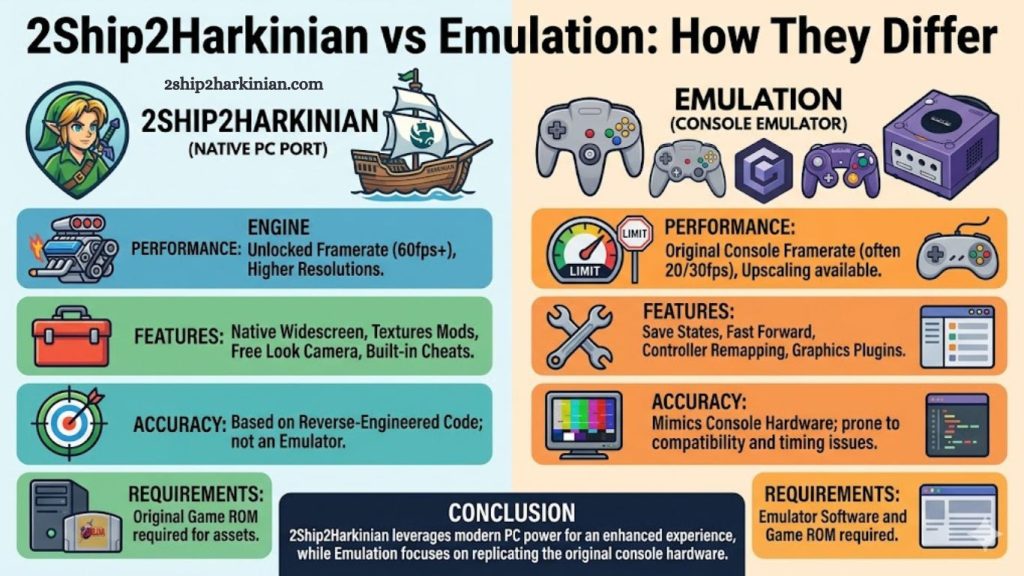
2Ship2Harkinian provides performance improvements through direct system access. Frame rates can exceed the original hardware’s limitations, and loading times often decrease significantly due to modern storage and processing advantages.
Emulation performance varies based on emulator accuracy settings, plugins, and system hardware. Some games run flawlessly, while others may experience audio desync, graphical glitches, or frame pacing issues due to imperfect hardware replication.
Optimization in 2Ship2Harkinian focuses on enhancing the experience rather than preserving hardware constraints. Emulation focuses on authenticity, even if that means retaining original limitations.
Visual Enhancements and Display Support
2Ship2Harkinian supports modern display standards, including widescreen resolutions and high refresh rates. These features allow the game to adapt naturally to modern monitors without stretching or artificial modification layers.
Emulators can also support higher resolutions and widescreen hacks, but these often depend on community plugins or external patches. Visual enhancements in emulation may require manual configuration and do not always integrate seamlessly.
Native rendering in 2Ship2Harkinian produces a more consistent visual upgrade because the system is built with modern output standards in mind from the beginning.
Control Systems and Input Flexibility
2Ship2Harkinian integrates modern control schemes directly into its design. Keyboard, mouse, and controller inputs can be mapped more intuitively, often with less configuration required.
Emulation requires input mapping through virtual controller setups. While flexible, this process can introduce complexity for users unfamiliar with emulator configuration tools.
Responsiveness also tends to feel more direct in native ports since input signals do not pass through hardware emulation layers before reaching the game logic.
Modding and Community Features
2Ship2Harkinian offers extensive mod support through a growing community ecosystem. Players can access texture enhancements, quality-of-life improvements, and gameplay modifications designed specifically for the native engine.
Emulators also support mods, but implementation often depends on ROM hacks or external patch files. These modifications may require technical knowledge and compatibility checks between emulator versions and game builds.
Community development around 2Ship2Harkinian focuses on expanding the game’s native capabilities rather than modifying emulated behavior.
Accuracy Versus Enhancement Philosophy
Emulation prioritizes historical accuracy. Developers aim to replicate the original console experience as closely as possible, including limitations and imperfections.
2Ship2Harkinian prioritizes modernization. The goal is to improve gameplay accessibility, visual quality, and performance while maintaining the core design of the original game.
This philosophical difference defines how each system evolves. Emulation preserves history, while native ports evolve it.
Stability and User Experience
2Ship2Harkinian generally offers a more stable user experience due to its direct integration with modern operating systems. Crashes and performance issues are less common when properly installed and configured.
Emulators may require frequent updates and fine-tuning depending on system compatibility. Stability can vary across different games and emulator versions.
User experience in native ports tends to be more streamlined, especially for players who prefer plug-and-play functionality.
Legal and Development Context
Emulation exists within a well-established legal framework. Emulators themselves are legal software tools, though the use of game ROMs depends on ownership and regional copyright laws.
2Ship2Harkinian operates in a different space as a reverse-engineered port. It typically requires original game assets, and users must provide legally obtained data to run the game.
Both approaches emphasize preservation, yet they operate under different development philosophies and legal considerations.
System Requirements and Accessibility
2Ship2Harkinian runs efficiently on modern PCs due to optimized native code. Even mid-range systems can achieve high performance without specialized configuration.
Emulation demands more variability in system requirements depending on the emulator and settings used. Higher accuracy settings often require more processing power.
Accessibility improves in native ports because users spend less time configuring technical settings before gameplay.
Community Impact and Ongoing Development
2Ship2Harkinian continues to evolve through active community contributions. Developers focus on expanding features, improving compatibility, and refining gameplay enhancements.
Emulation communities also remain highly active, contributing to improvements in accuracy, bug fixes, and support for a wide range of systems beyond the Nintendo 64.
Both communities play important roles in game preservation, though their objectives differ in execution and outcome.
Frequently Asked Questions
What is 2Ship2Harkinian?
2Ship2Harkinian is a native PC port of The Legend of Zelda: Majora’s Mask built through reverse engineering.
How is 2Ship2Harkinian different from emulation?
2Ship2Harkinian runs the game natively on PC, while emulation simulates the original console hardware to run it.
Does 2Ship2Harkinian require an emulator?
No, it does not require an emulator because it runs as a standalone application on modern systems.
Which performs better, emulation or 2Ship2Harkinian?
2Ship2Harkinian generally offers better performance due to native execution and reduced system overhead.
Can emulation provide the same enhancements as 2Ship2Harkinian?
Emulation can add enhancements through mods and plugins, but setup is often more complex and less integrated.
Is 2Ship2Harkinian legal to use?
The software itself is legal, but users must provide their own legally obtained game files.
Which option is better for playing classic games today?
2Ship2Harkinian suits users seeking modern performance, while emulation suits those who prefer original hardware accuracy.
Conclusion
2Ship2Harkinian and emulation both preserve classic gaming experiences, yet they follow different paths. 2Ship2Harkinian delivers a modern, native PC experience with improved performance, higher resolutions, and smoother controls. Emulation focuses on recreating original console hardware, keeping gameplay as authentic as possible.