2Ship2Harkinian has gained strong attention in the gaming community for bringing a classic experience to modern systems. Many players search for clarity about its nature, especially whether it functions as an emulator or something entirely different. A clear understanding helps users avoid confusion and appreciate the technical achievement behind this project.
Understanding the Purpose of 2Ship2Harkinian
2Ship2Harkinian serves as a modern reimplementation of a classic Nintendo 64 title. Developers created it through a decompilation process that converts the original game code into readable, rebuildable source code. That approach allows the game to run natively on modern operating systems instead of simulating hardware.
Emulators recreate the behavior of old consoles by mimicking their hardware and system architecture. 2Ship2Harkinian does not follow that method. Instead, it reconstructs the game to run directly on a PC, delivering improved performance and compatibility.
Read More: 2Ship2Harkinian (2S2H) Explained
Why 2Ship2Harkinian Is Not an Emulator
Emulation relies on software that imitates a console’s CPU, GPU, memory structure, and system calls. That method introduces overhead because every instruction must translate into a simulated environment.
2Ship2Harkinian avoids that layer entirely. The project compiles game logic into native code that executes directly on modern hardware. That difference fundamentally separates it from traditional emulators.
Performance improvements represent one of the clearest distinctions. Emulator-based gameplay often depends on system power to handle simulation workloads. Native execution reduces that burden and enables smoother frame rates, lower input latency, and enhanced graphical options.
Core Technology Behind 2Ship2Harkinian
Decompilation forms the foundation of this project. Developers analyze original game binaries, reconstruct their logic, and rewrite them into high-level programming languages such as C or C++.
After reconstruction, the code compiles for modern platforms. That process transforms a console-dependent game into a standalone application that no longer requires emulated hardware.
Modular design also plays an important role. Developers can modify assets, improve rendering pipelines, and implement quality-of-life features without altering emulator settings or ROM patches.
Key Differences Between Emulation and Native Ports
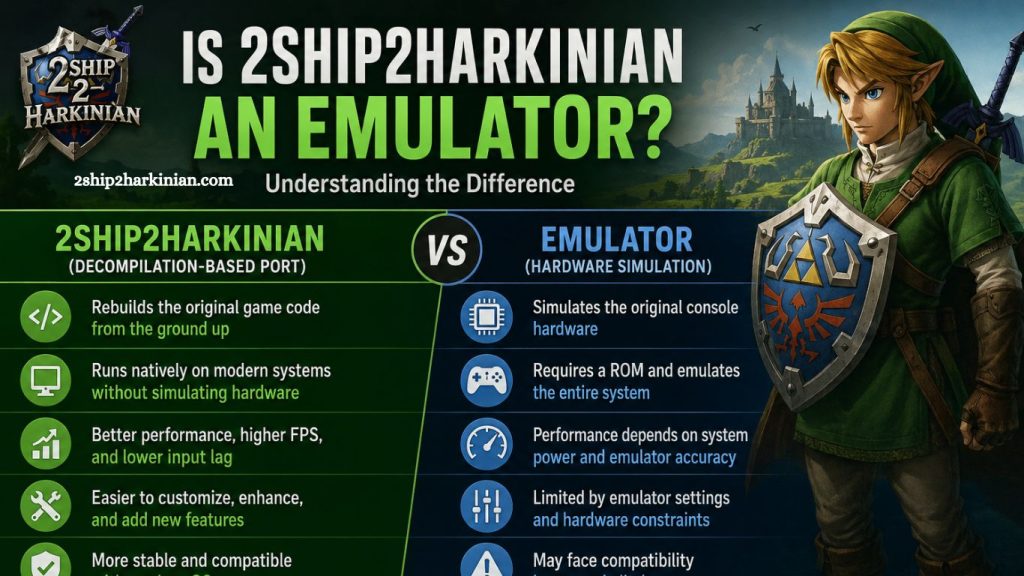
Emulation simulates original hardware behavior, while decompilation-based ports rebuild software for new environments. Several distinctions highlight the contrast:
- Emulators depend on ROM files and system simulation
- Decompiled ports run as independent applications
- Emulation introduces hardware abstraction layers
- Native ports execute instructions directly on the CPU
- Emulator performance varies based on system configuration
- Decompiled builds deliver more consistent optimization potential
2Ship2Harkinian belongs firmly in the second category, offering a reconstructed experience rather than a simulated one.
Performance Advantages of 2Ship2Harkinian
Modern systems handle native applications more efficiently than emulated environments. 2Ship2Harkinian leverages that capability by removing unnecessary translation layers.
Higher frame rates become possible due to direct hardware utilization. Reduced input latency improves responsiveness, especially in action-heavy gameplay scenarios. Visual enhancements such as widescreen support, higher resolutions, and improved textures also become easier to implement.
System stability also benefits from this structure. Emulators sometimes struggle with compatibility issues tied to different hardware architectures. Native builds avoid many of those problems by operating within standard operating system frameworks.
Community Impact and Development Significance
Gaming communities often celebrate projects like 2Ship2Harkinian because they preserve classic experiences while modernizing technical foundations. Developers contribute significant effort to reverse-engineer older titles, ensuring they remain playable on future systems.
Open-source collaboration strengthens the project’s evolution. Contributors regularly improve performance, fix bugs, and expand features. That collaborative environment supports long-term sustainability beyond what traditional emulation setups usually achieve.
Preservation also plays a key role. Many classic games face hardware limitations due to aging consoles. Decompiled projects provide an alternative pathway that keeps these experiences accessible without relying on obsolete systems.
Legal and Ethical Considerations
Decompilation projects operate under a different legal framework than emulation. Emulators generally remain legal because they do not include copyrighted code. Decompiled projects rely on reconstructed code, which may require the original game assets to function fully.
Users typically need legally obtained game files to use such projects. That requirement ensures compliance with intellectual property rules while still allowing enhanced gameplay experiences.
Developers usually avoid distributing copyrighted assets, focusing instead on engine reconstruction and technical improvement.
Why Confusion About Emulation Exists
Many players associate any form of retro gaming on PC with emulation. That assumption creates misunderstanding when encountering projects like 2Ship2Harkinian.
Graphical improvements, controller support, and PC compatibility often resemble emulator features. Surface-level similarities lead users to categorize both approaches under the same label.
Technical differences remain significant despite similar outcomes. Emulation imitates old hardware behavior, while decompilation rebuilds software for modern execution environments.
Real-World Example of the Difference
An emulator scenario requires a ROM file and an emulator application. The emulator reads the ROM and simulates console behavior step by step.
2Ship2Harkinian scenario runs as a compiled PC program. The game logic executes directly, without interpreting console instructions.
That distinction explains why performance and customization options often exceed those of traditional emulators.
Frequently Asked Questions
Is 2Ship2Harkinian an emulator?
No, 2Ship2Harkinian is not an emulator. It is a native PC port created through decompilation, allowing the game to run directly on modern systems.
How does 2Ship2Harkinian work?
It works by reconstructing the original game code into readable source code and compiling it for modern operating systems, rather than simulating console hardware.
Do I need a ROM to use 2Ship2Harkinian?
Yes, users typically need legally obtained game files to run the project since it does not include copyrighted assets.
Is 2Ship2Harkinian legal?
The project itself is generally legal because it does not distribute original game assets. However, users must ensure they use legally owned copies of the game.
What are the benefits of 2Ship2Harkinian over emulators?
It offers better performance, lower input lag, higher resolutions, widescreen support, and improved stability compared to traditional emulation.
Can I play it on any operating system?
2Ship2Harkinian is mainly designed for modern Windows, Linux, and macOS systems, depending on available builds and community support.
Why do people confuse it with an emulator?
People often confuse it with emulators because it runs classic games on PC, but technically, it executes native code rather than simulating hardware.
Conclusion
2Ship2Harkinian is not an emulator but a decompilation-based native PC port that rebuilds classic game code for modern systems. This approach removes the need for hardware simulation and delivers stronger performance, smoother gameplay, and enhanced visual options. Emulation and decompilation achieve similar goals of game preservation, yet they operate through fundamentally different methods.